Difference between revisions of "Category:ECO:0000053 ! computational combinatorial evidence"
(update ECO:0000053_!_computational_combinatorial_evidence page) |
(update ECO:0000053_!_computational_combinatorial_evidence page) |
||
| Line 2: | Line 2: | ||
'''name:''' computational combinatorial evidence<br> | '''name:''' computational combinatorial evidence<br> | ||
'''def:''' "A type of combinatorial analysis where data are combined and evaluated by an algorithm." [ECO:go, ECO:MCC]<br> | '''def:''' "A type of combinatorial analysis where data are combined and evaluated by an algorithm." [ECO:go, ECO:MCC]<br> | ||
| − | '''xref:''' [http://arabidopsis.org/servlets/TairObject?type=communication&id=TED | + | '''xref:''' [http://arabidopsis.org/servlets/TairObject?type=communication&id=TED TAIR:TED]<br> |
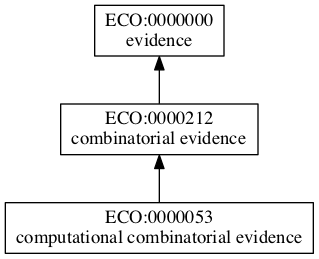
'''is_a:''' [[:Category:ECO:0000212 ! combinatorial evidence|ECO:0000212 ! combinatorial evidence]][[Category:ECO:0000212 ! combinatorial evidence|ECO:0000212 ! combinatorial evidence]]<br> | '''is_a:''' [[:Category:ECO:0000212 ! combinatorial evidence|ECO:0000212 ! combinatorial evidence]][[Category:ECO:0000212 ! combinatorial evidence|ECO:0000212 ! combinatorial evidence]]<br> | ||
'''comment:''' Combinatorial analyses could include experimental or computational results. Examples include: (i) large-scale experiment such as a genome-wide two-hybrid or genome-wide synthetic interactions; (ii) integration of large-scale data sets of various types; and (iii) text-based-computation, e.g. text-mining. For simple sequence comparisons, one should use the sequence similarity analysis evidence type. For microarray results alone, expression pattern analysis is appropriate; whereas, large-scale computational analysis should be used when microarray results are combined with the results of other types of large-scale experiments.<br> | '''comment:''' Combinatorial analyses could include experimental or computational results. Examples include: (i) large-scale experiment such as a genome-wide two-hybrid or genome-wide synthetic interactions; (ii) integration of large-scale data sets of various types; and (iii) text-based-computation, e.g. text-mining. For simple sequence comparisons, one should use the sequence similarity analysis evidence type. For microarray results alone, expression pattern analysis is appropriate; whereas, large-scale computational analysis should be used when microarray results are combined with the results of other types of large-scale experiments.<br> | ||
Revision as of 17:59, 24 October 2017
| id: ECO:0000053 name: computational combinatorial evidence |
 | ||
|
The contents of this box are automatically generated. You can help by adding information to the "Notes"
Usage Notes
References
See Help:References for how to manage references in OMPwiki.
This category currently contains no pages or media.

