Difference between revisions of "Category:ECO:0005531 ! motif discovery evidence"
(update ECO:0005531_!_motif_discovery_evidence page) |
(update ECO:0005531_!_motif_discovery_evidence page) |
||
| Line 3: | Line 3: | ||
'''def:''' "A type of multiple sequence alignment evidence based on a set of algorithms that infer over-represented motifs from a set of biological sequences returning one or more local multiple sequence alignment defining the inferred motifs." [ECO:SW, PMID:10812473, PMID:16845028, PMID:8211139]<br> | '''def:''' "A type of multiple sequence alignment evidence based on a set of algorithms that infer over-represented motifs from a set of biological sequences returning one or more local multiple sequence alignment defining the inferred motifs." [ECO:SW, PMID:10812473, PMID:16845028, PMID:8211139]<br> | ||
'''is_a:''' [[:Category:ECO:0005555 ! multiple sequence alignment evidence|ECO:0005555 ! multiple sequence alignment evidence]][[Category:ECO:0005555 ! multiple sequence alignment evidence|ECO:0005555 ! multiple sequence alignment evidence]]<br> | '''is_a:''' [[:Category:ECO:0005555 ! multiple sequence alignment evidence|ECO:0005555 ! multiple sequence alignment evidence]][[Category:ECO:0005555 ! multiple sequence alignment evidence|ECO:0005555 ! multiple sequence alignment evidence]]<br> | ||
| − | '''comment:''' Relationship type between sequences (e.g. orthologs from multiple genomes or co-expressed genes in the same genome) is not necessarily assumed. The local multiple sequence alignment is typically ungapped. A common application of motif discovery is to infer the binding motif of a given transcription factor (TF). This can be based on the results of a whole-genome expression analysis, assuming that co-expressed genes are co-regulated by the same TF | + | '''comment:''' Relationship type between sequences (e.g. orthologs from multiple genomes or co-expressed genes in the same genome) is not necessarily assumed. The local multiple sequence alignment is typically ungapped. A common application of motif discovery is to infer the binding motif of a given transcription factor (TF). This can be based on the results of a whole-genome expression analysis, assuming that co-expressed genes are co-regulated by the same TF, from peaks in ChIP-seq experiments with the TF, or from the comparative genomics analysis of the promoter regions of orthologs. {xref="PMID:19892760", xref="PMID:23032607"}<br> |
}} | }} | ||
== Usage Notes == | == Usage Notes == | ||
Latest revision as of 03:00, 4 December 2017
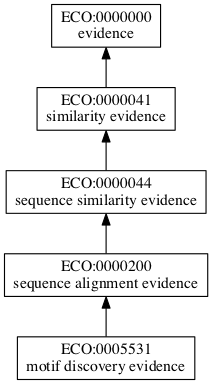
| id: ECO:0005531 name: motif discovery evidence |
 | ||
|
The contents of this box are automatically generated. You can help by adding information to the "Notes"
Usage Notes
References
See Help:References for how to manage references in OMPwiki.
Child Terms
This category has the following 3 subcategories, out of 3 total.

